13x4 vs 13x6 Lace Front: Lace Sizes Explained
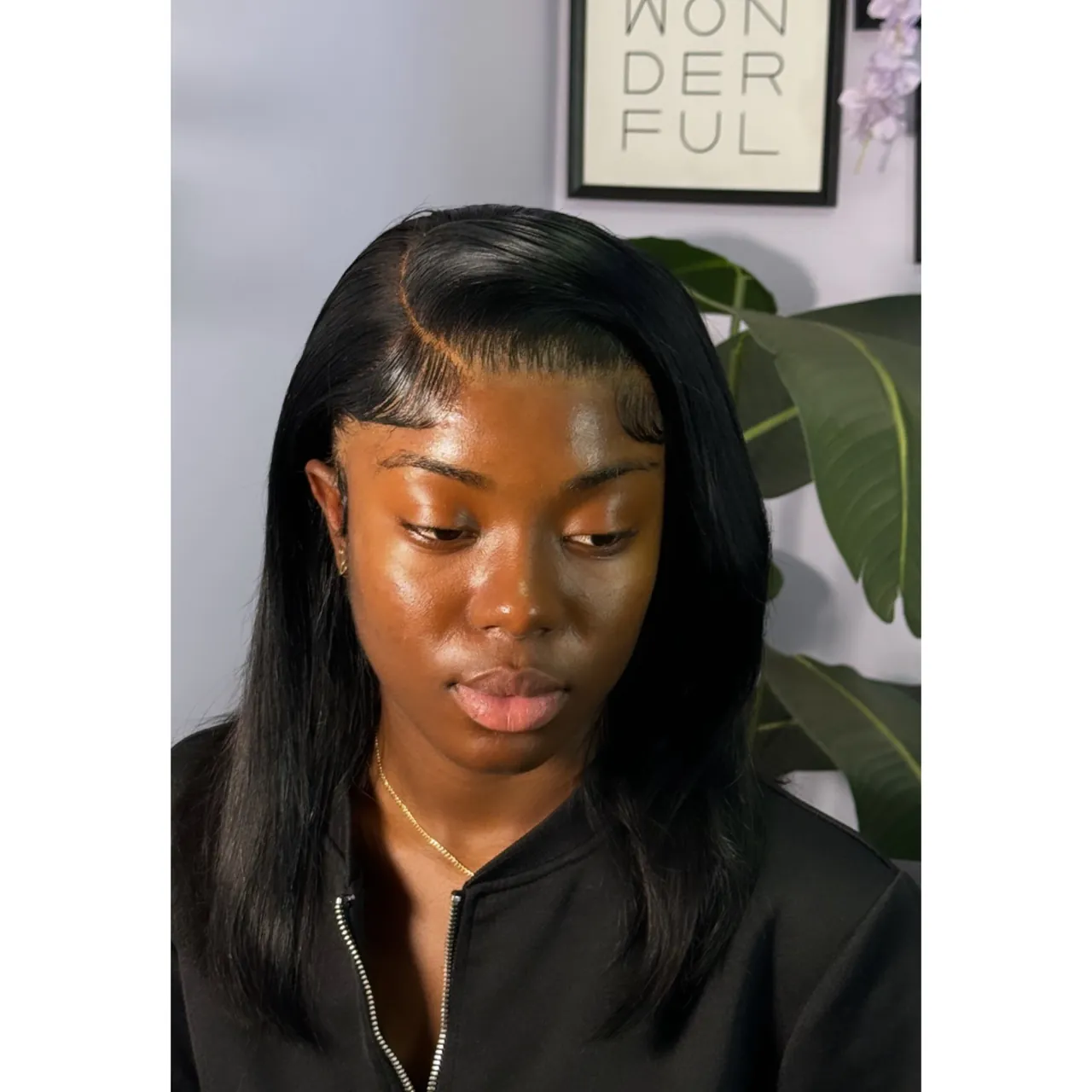
Every lace front listing throws numbers at you: 13x4, 13x6, 180 density, HD, 22 inches, pre plucked. Clients bring me those listings before they buy, and the same handful of questions decide whether the unit will be a good one.
A 13x4 lace front wig has a lace panel 13 inches wide across the hairline and 4 inches deep from the hairline back, which gives an ear to ear hairline and about 4 inches of parting room. A 13x6 is the same width with 6 inches of depth for deeper parts. Below is what every other number on the listing means, and what the install costs once you have the wig.
What 13x4 means, and how it compares with 13x6
The first number is the width of the lace across the front, the second is how far back it goes. Both are in inches.
13x4
Thirteen inches is roughly ear to ear on most heads, so a 13x4 gives you a lace hairline the whole way across, including the temples. Four inches back is enough for a middle part, a side part and a swept front. It is the most common frontal size, the easiest to find in every texture, and the one I install most.
13x6
Same width, two more inches of depth. The extra depth lets you part deeper, slick the front back with the part on display, and change the part more often without reaching the edge of the lace. It costs a little more because there is more hand tied area, and it needs a little more customization at install.
13x5 and 13x7
Some makers split the difference or go deeper. The logic is the same: more depth, more parting room, more lace to lay.
Which to buy
Buy 13x4 for most styles and the widest choice of units. Buy 13x6 if you love a deep side part, a slicked back look, or you change your part week to week. For a middle part and hair down, a 5x5 closure may be all you need; my closure wig install is $130 against $140 for a frontal. The frontal install itself is described on my lace frontal install page.
Lace type and transparency
The lace is what you are paying for in a 13x4. Three kinds are common, and the listing will name one.
- Swiss lace. The sturdiest and slightly more visible. Forgiving for beginners and for anyone handling the lace at home. Often needs tinting to match deeper scalps.
- Transparent lace. Thinner and lighter than standard Swiss, with a see through look that blends on a wide range of skin tones with little tinting. A good middle choice.
- HD lace. The thinnest and most invisible once laid, which is why it is in every listing title now. It is also the most delicate and tears easily, so it belongs with careful hands and a professional install.
Whatever the lace, the knots still need bleaching so the part does not show dots, and the lace tone may need a tint to match your scalp. HD lace needs the least tint; Swiss the most. Both steps are included in my install.
Lace also comes in colors: light brown, medium brown and dark brown, and some makers offer a tone for very deep scalps. Matching the lace tone to your scalp cuts the tinting work and makes the part look like skin from the first wear. If you are between tones, go lighter and let me tint it darker; dark lace cannot be lightened.
Density and coverage
Density is how much hair is tied into the cap, written as a percentage. It decides how full the wig looks and how natural the hairline reads.
| Density | How it looks | Best for |
|---|---|---|
| 130% | Light, close to natural fine hair | Short styles, straight textures, a very natural hairline |
| 150% | Natural medium fullness | Everyday wear in most textures and lengths |
| 180% | Full, with body | Wavy and curly textures, longer lengths, the most popular choice |
| 200% to 250% | Very full, heavy | Glam and voluminous looks, deep waves; needs a heavier pluck at the front |
A rule I give clients: the longer and curlier the hair, the more density you need before it looks thin; the straighter and shorter, the less. The hairline is a separate question from the overall density. Even a 250 density unit should fade in at the edge, which is what plucking does. If the listing says pre plucked, I still refine it for your face.
Density and length work together. A 180 density 16 inch bob reads very full; the same density at 30 inches reads medium because the hair spreads over more length. Listings that advertise 250 density at short lengths are often heavier than most faces want, and a long unit at 130 density can look sparse at the ends.
Hair type and material
The hair tied into the lace is either human or synthetic, and within human hair there are grades. This is the biggest factor in how the unit looks, moves and lasts.
Human hair
Human hair can be heat styled, colored, washed and reinstalled many times, and it moves and shines like your own. Listings describe it as virgin, which means unprocessed, or Remy, which means the cuticles run in one direction so it tangles less. Both are good; virgin Remy is the top of the range. Bundles of human hair come in origins like Brazilian, Peruvian and Malaysian, which mostly describe texture and thickness rather than a guarantee of source.
Synthetic
Synthetic 13x4 lace fronts are far cheaper and come styled, with the wave or curl set into the fiber. Most cannot take heat or color, they can look shiny under flash, and they last weeks of wear rather than months. Heat friendly synthetics exist and can take low heat. For a unit you plan to wear daily and reinstall, human hair is the better investment; for an event or a trial of a new color, synthetic is a reasonable choice.
Blends
Some units mix human and synthetic fiber to lower the price. Treat them as synthetic for heat and color.
Wig length and sizing
Length is measured in inches from the crown to the ends with the hair pulled straight, so a curly 20 inch unit sits well above a straight 20 inch unit. Cap size decides whether the lace sits flat and the unit stays put.

Length guide
- 10 to 14 inches: bobs and shoulder length
- 16 to 20 inches: below the shoulder to mid back; the most common range
- 22 to 26 inches: mid back to waist on most heights
- 28 inches and up: waist length and longer, heavy, needs high density to look full
Cap size
Most units ship in a medium cap, usually around 22 to 22.5 inches in circumference, with small and large caps available from some makers. Measure your head from the front hairline, around behind the ears, to the nape and back, with your hair flat as it will be under the wig. A cap that is too big shifts and shows lace at the temples; too small sits up at the nape and strains the lace. Adjustable straps, combs and an elastic band give a little room either way, and a custom fit is part of my glueless install.
How to measure
- Flatten your hair as it will be under the wig, braided or wrapped.
- Run a soft tape from the front hairline, down behind one ear, around the nape, up behind the other ear and back to the start. That is the circumference.
- Measure from the front hairline straight over the crown to the nape for front to back.
- Measure ear to ear across the top of the head, and ear to ear across the forehead along the hairline.
Compare those four to the maker's chart. If you sit between sizes, choose the smaller cap for glueless and the larger for adhesive, where the lace does the holding.
Styles and textures, and what works for Black women
A 13x4 comes in every texture, and the right one is the one that blends with your own hair at the edges and suits how you wear it. These are the common names on a listing.
- Straight and bone straight. Sleek, shows the part and hairline the most, so lace and pluck quality matter most here.
- Kinky straight and yaki. Straight with the texture of blown out natural hair. Blends with 4C and 4B edges far better than silky straight, and looks like your own hair pressed.
- Body wave. Loose S waves, the easiest texture to wear and maintain.
- Loose wave and loose deep. Bigger, softer curls with movement.
- Deep wave. Tighter, defined curls with lots of volume; wants 180 density or more.
- Water wave and wet and wavy. Beachy, crimped waves that look wet; water wave is the most forgiving at the hairline because the texture hides the edge.
- Curly and kinky curly. Tight curls that mimic natural 3C to 4A hair, beautiful with natural edges.
Most of my wig clients in Queens are Black women wearing a 13x4 as a protective style, so the unit has to work with braided down natural hair and with edges that are 4C. What works: kinky straight or yaki for a pressed look, kinky curly or deep wave for a natural curl, a lace tone that matches a deeper scalp or transparent lace that tints easily, and a pluck that leaves the hairline soft rather than a wall. Baby hair laid with a little gel and a scarf for twenty minutes finishes it. A 13x4 also lets you keep the hair off your face for work and wear it down for the weekend without changing the unit.
Pre plucked and glueless features
Two features in listing titles change the install: pre plucked hairlines and glueless caps. Both help; neither replaces the work in the chair.
Pre plucked
A pre plucked unit has had some hair removed along the front edge at the factory, so the hairline is thinner than the rest of the cap. It is a head start. Factory plucking is uniform and often still too dense, and it is never shaped to your face, so I refine it, pluck the part, and bleach the knots as part of every install. Pre bleached knots on the listing mean the same thing: partly done.
Glueless
A glueless 13x4 has an elastic band, combs and an adjustable cap so it holds without adhesive. It is the kindest option for sensitive skin and edges, you can remove it at night, and reinstalling is simple. My glueless wig install is $150 and uses no glue or tape at all, with a custom fit to your head. Frontals worn glueless hold a little less flat at the temples than with adhesive, so for slicked back styles I often recommend adhesive at the edges.
Wear and go
Wear and go units are pre cut, pre plucked and glueless, meant to go on in minutes. They are convenient, and they still look better once the lace has been tinted and the hairline refined for your face.
Pre cut lace is the one feature to be careful with. A factory cut is a straight line with no peak and no temple shape, and it is cut once. If it is cut too far back, there is no lace left to fix it. I prefer a unit with the lace uncut so I can follow your hairline.
Price, and what to budget for the install
A 13x4 lace front ranges from under a hundred dollars for a synthetic unit to several hundred for long, dense, virgin human hair with HD lace. Then there is the install, which is where the hairline is made.
- Lace front wig install: $140, about two hours, $40 deposit. Includes braid down or blow dry, scalp treatment, knot bleaching, plucking and styling. Drop the wig off two to three days before.
- Glueless wig install: $150, two hours, no glue or tape, custom fit.
- Lace wig reinstall for a unit you own: $140, 90 minutes.
- Same day wig install: $350, when there is room in the day.
- Customized lace with color: ask when you book.
A realistic first budget is the unit plus the $140 install, then a reinstall at $140 whenever the lace lifts. Over a few months a human hair unit reinstalled twice costs far less per wear than three synthetic units bought new.
Spend on the hair first, the lace second, the density third. A mid range human hair 13x4 with transparent lace and 150 to 180 density, properly installed, will outlast and look better than an expensive HD unit installed badly. If you are deciding between two listings, message me the links before you buy. All hair services are on the Queens hair services page.
Bring your 13x4 to Springfield Gardens
Once you have your 13x4, bring it to Tyca Beaute on 232nd Street in Springfield Gardens, Queens, two to three days before your appointment and I will customize it before you sit down. Details and the booking link are on the lace frontal install page; the install is $140 with a $40 deposit.
Questions readers ask
Is a 13x4 enough for a side part?
Yes. Four inches of depth covers a standard side part and a swept front. A deep side part or a slicked back look with the part showing is where a 13x6 helps.
Does a 13x4 cover the temples?
Yes. Thirteen inches runs roughly ear to ear, so the lace sits at the temples and the whole front hairline can be laid against the skin.
What density should a first 13x4 be?
150 for straight hair, 180 for wavy or curly. Both look natural once the hairline is plucked; very high density needs a heavier pluck at the front.
Can you cut and style a 13x4 after the install?
Yes. Human hair units can be cut, curled and straightened in the chair as part of the styling step; synthetic units can only be styled within what the fiber allows.